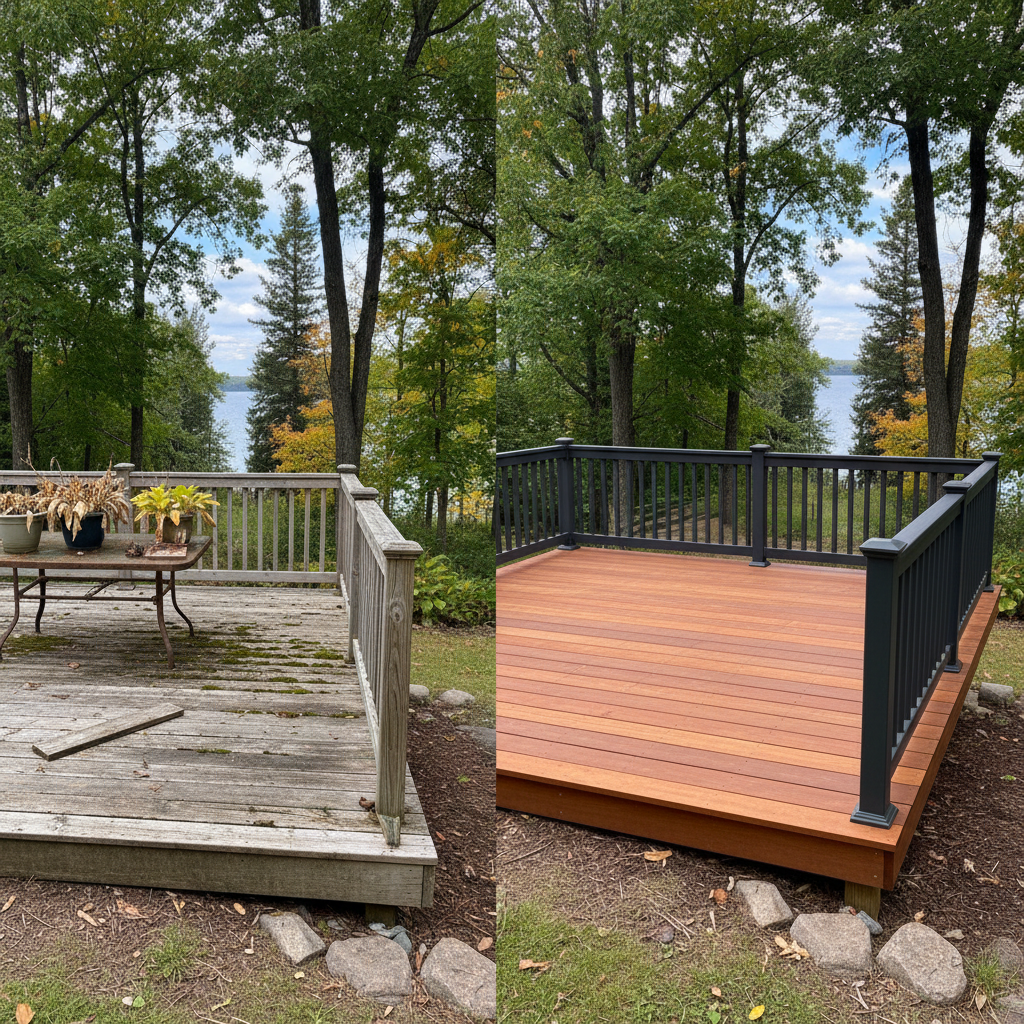
Your deck's seen better days, huh? Maybe a few rotten boards, some splintering, or just looking tired. You're probably wondering if you can just swap out the bad stuff or if you need to think bigger. As someone who's fixed more decks than I can count around Duluth, I can tell you there are two main ways to approach this: board-by-board repair or a more significant sectional overhaul.
Board-by-Board Repair: The Spot Fix
This is exactly what it sounds like. You identify the specific damaged boards – maybe a few deck boards, a railing post, or a couple of balusters – and you replace just those. It's often the first thing people think of because, on the surface, it seems like the cheapest and easiest option.
When it Makes Sense:
- Isolated Damage: If you've got just a handful of boards that are truly bad, and the rest of the deck is in solid shape, this is a good call. Think about a few boards that got hit by a falling branch, or maybe one section that consistently gets more moisture and rotted out prematurely.
- Newer Decks: For decks that are only 5-10 years old, where the structural integrity is still excellent, but a few surface pieces have failed.
- Budget Constraints: You're really trying to stretch your dollar, and you can't afford a bigger project right now.
The Downsides:
- Matching Materials: This is a big one. Unless your deck is brand new, finding new lumber that perfectly matches the aged, weathered look of your existing deck is tough. New pressure-treated lumber will look bright green or yellowish compared to your graying boards. Even with staining, you'll often see a difference. For composite decks, manufacturers change colors and profiles, so a perfect match might be impossible.
- Hidden Problems: You pull up a few bad boards, and suddenly you see the joists underneath are also compromised, or the flashing against the house is shot. What started as a small repair can quickly snowball.
- Durability Mismatch: You're putting new material next to old. The new stuff might last another 15-20 years, but the old stuff around it might only have 5-7 years left. You could be doing this again sooner than you'd like.
- Labor Efficiency: Sometimes, carefully cutting out and replacing individual boards can be almost as time-consuming as replacing a whole section, especially if you're trying to save surrounding material.
Sectional Overhaul: The Strategic Upgrade
A sectional overhaul means you're replacing a larger, contiguous area of your deck. This could be an entire railing system, a full section of decking boards (say, everything from the house out to a beam), or even a specific level of a multi-level deck. You're not just swapping out bad pieces; you're upgrading a whole zone.
When it Makes Sense:
- Widespread Deterioration: If you've got rot or significant wear spread across a larger area, not just a few isolated spots. Maybe the entire railing is wobbly, or a whole corner of the deck is soft.
- Age of the Deck: For decks that are 15+ years old, even if some boards look okay, their useful life might be nearing its end. A sectional overhaul can extend the life of the entire structure significantly.
- Aesthetic Upgrade: This is a great opportunity to improve the look. You can switch from wood to composite in that section, update railing styles, or even change the layout slightly.
- Addressing Underlying Issues: If you know you have a drainage problem in one area, or the foundation footings in a specific spot aren't quite right (which we see sometimes with our clay soils here in Duluth), a sectional overhaul lets you fix those core problems while you're at it.
- Better Material Matching: While you still might not match the *entire* deck, replacing a whole section means the new material will look uniform within that section, which is much more visually appealing than a patchwork of old and new boards.
The Downsides:
- Higher Upfront Cost: No getting around it, replacing more material costs more.
- More Involved Project: It takes longer and involves more disruption than a simple board swap.
My Takeaway for Duluth Homeowners
Look, I'm not going to tell you to always go for the bigger project. If your deck is relatively new and you've got two or three truly isolated, damaged boards, a board-by-board repair is probably fine. Just be prepared for potential color differences.
But for most decks I see around here – especially those that are 10+ years old and showing general wear – I lean towards a sectional overhaul. Why? Because our winters are brutal. The freeze-thaw cycles, the heavy snow loads, the constant moisture from melting ice – it all takes a toll. When one section of wood is failing, chances are the wood around it isn't far behind, even if it looks okay on the surface.
You'll get a more durable, longer-lasting repair, and honestly, it'll look a whole lot better. You won't have that